


.webp)
Be honest.
How many virtual meetings have you joined where someone is:
- eating directly into the microphone
- driving and talking at the same time
- clearly answering emails while you’re speaking
Asking “Sorry, what was decided?” at the very end
We’ve all been there.
Virtual meetings are now part of everyday work. But just because we’re used to them doesn’t mean we’re good at them.
And the small habits people ignore? They quietly damage trust, credibility, and productivity. That’s where virtual meeting etiquette comes in.
What Is Virtual Meeting Etiquette?
Virtual meeting etiquette is the set of behaviors that make online meetings feel professional rather than chaotic.
It’s not about being overly formal. It’s about basic respect — for time, attention, and other people’s work.
Virtual meeting etiquette includes things like:
- Joining on time
- Muting when you’re not speaking
- Actually listening instead of multitasking
- Speaking clearly and staying on topic
Not turning your camera into a distraction
Sounds obvious, right?
Yet most frustrations in remote teams come from ignoring exactly these basics. Online meeting etiquette exists for one reason: to make communication smoother when we don’t share the same room.
Meeting Etiquette vs. Meeting Effectiveness
Here’s where most teams get confused.
They think that if everyone behaves politely, the meeting will be successful.
Not necessarily.
Let’s separate two things:
Etiquette = how you behave.
Are you respectful? Focused? Prepared?
Effectiveness = what the meeting produces.
Did you leave with decisions? Clear owners? Deadlines?
You can have a polite meeting that leads nowhere.
You can also have a productive meeting that feels chaotic.
The best professional meetings combine both:
- Respectful behavior
- Clear structure
- Defined next steps
Because in the end, virtual meeting etiquette is not just about looking professional. It’s about making sure the meeting actually moves work forward.
If you want to go beyond behavior and learn how to structure calls for clear decisions and outcomes, read our guide on how to run effective virtual meetings.
Why Virtual Meeting Etiquette Matters in Modern Business
Impact on Team Productivity
Poorly managed online meetings waste time and drain energy. Background noise, interruptions, unclear agendas, and multitasking reduce focus and slow decision-making.
Following virtual meeting best practices — joining on time, staying engaged, muting when not speaking, and preparing in advance — improves remote team productivity. Structured communication helps teams move from discussion to action faster. When etiquette is strong, meetings become shorter, clearer and more outcome-driven.
Impact on Professional Reputation
In professional online meetings, small behaviors shape perception. Poor camera positioning, lack of preparation, or speaking over others can signal disorganization or disrespect. On the other hand, strong virtual meeting etiquette demonstrates reliability, clarity, and leadership. Clients and partners notice when you communicate clearly, respect time boundaries and follow structured discussion.
In remote business communication, your screen presence becomes part of your professional brand.
Impact on Meeting Follow-Ups and Execution
Many meetings fail not because of bad ideas, but because of weak follow-ups. When action points are unclear or not documented, productivity drops after the call ends.
Good virtual meeting etiquette includes:
- Summarizing key decisions
- Clarifying next steps
- Assigning responsibilities
- Confirming deadlines
Clear follow-ups turn conversations into measurable outcomes. This is especially important in distributed teams where miscommunication can delay projects. Strong meeting discipline improves execution and accountability across the organization.
Remote Meetings Amplify Every Mistake
In a physical meeting room, small mistakes often go unnoticed.
Online, they don’t.
An unmuted microphone with chewing or background noise instantly irritates everyone.
Joining from a moving car signals distraction. Multitasking becomes obvious when someone stares at another screen and asks, “Sorry, can you repeat that?” But the real damage isn’t the noise.
It’s the lack of structure.
- No agenda.
- No clear objective.
- No defined outcome.
The meeting starts with:
“So… what are we discussing?”
It drifts.
It runs longer than planned.
Decisions are vague.
And then at the end:
“Let’s follow up later.”
Later how?
Who owns what?
Where are the action items?
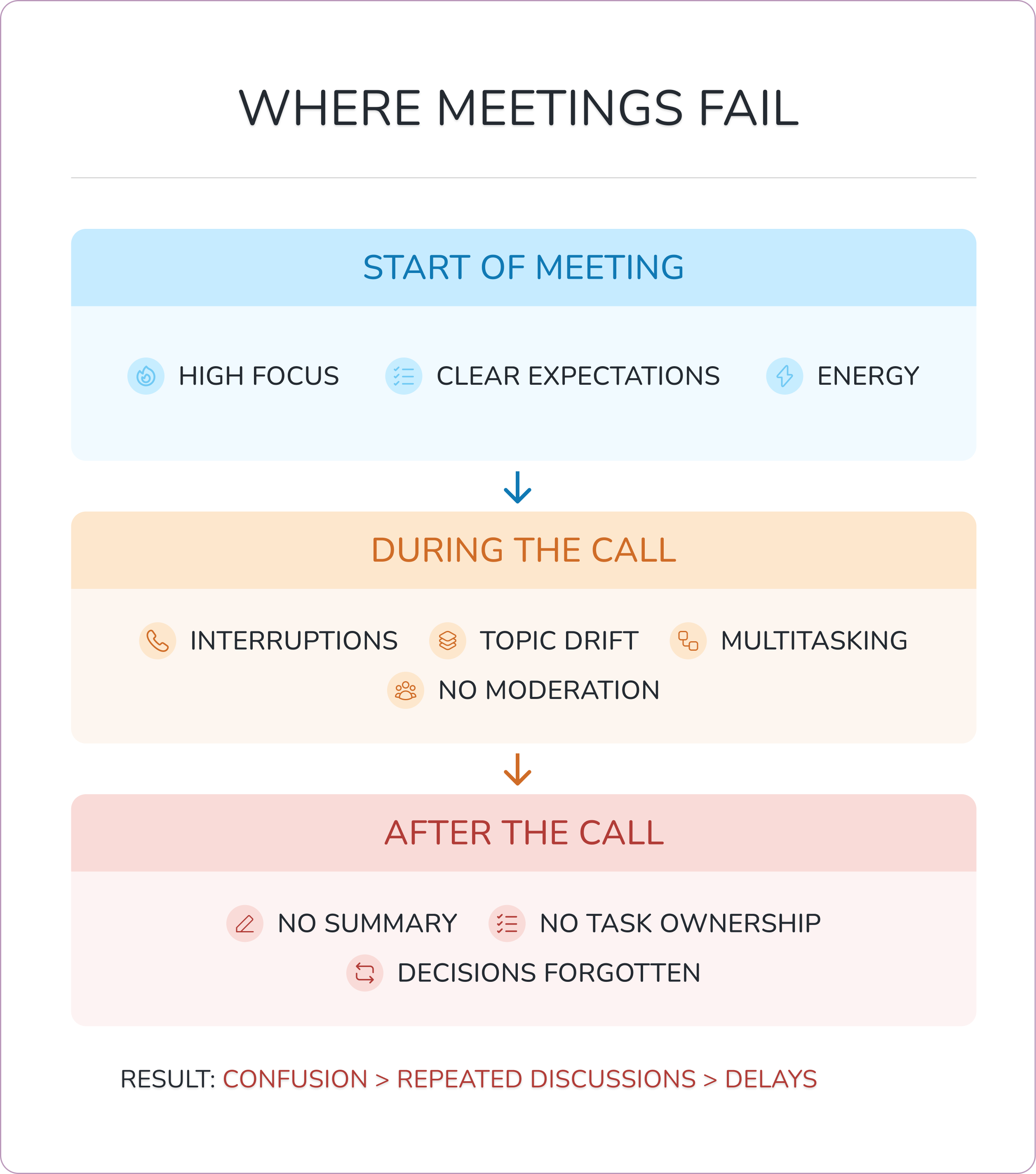
This is where most virtual meetings fail, not during the call, but after it.
.webp)
Discussions stay in scattered notes.
Tasks never get assigned.
Deadlines aren’t scheduled.
That’s why modern remote teams treat meeting etiquette as more than behavior.
They treat it as a system.
Instead of manually rewriting notes and chasing follow-ups, teams increasingly rely on tools that automatically convert spoken discussions into structured outcomes.
For example:
• AI-powered note capture can turn conversations into organized AI meeting notes.
• An intelligent AI planner can convert decisions into scheduled tasks and deadlines instantly.
• A personal booking link eliminates chaotic back-and-forth when scheduling the next meeting.
When conversations automatically become tasks and calendar events, etiquette stops being just “good manners” — it becomes operational discipline.
In distributed teams, this is the difference between meetings that feel busy and meetings that actually move work forward.
New research confirms that virtual meetings create a unique form of mental fatigue. According to a publication in the Journal of Occupational Health Psychology, participating in long virtual meetings is associated with increased levels of “passive fatigue,” which reduces participants' cognitive abilities and attention.
Virtual Meeting Etiquette Rules Every Professional Should Follow
Good intentions aren’t enough. Most people don’t join virtual meetings planning to be distracting or unprofessional. It just happens, because online meetings feel informal. But perception still matters. And in remote work, perception is often your reputation.
Here are the core virtual meeting etiquette rules every professional should follow, whether you’re a team member, a manager, or meeting a client.
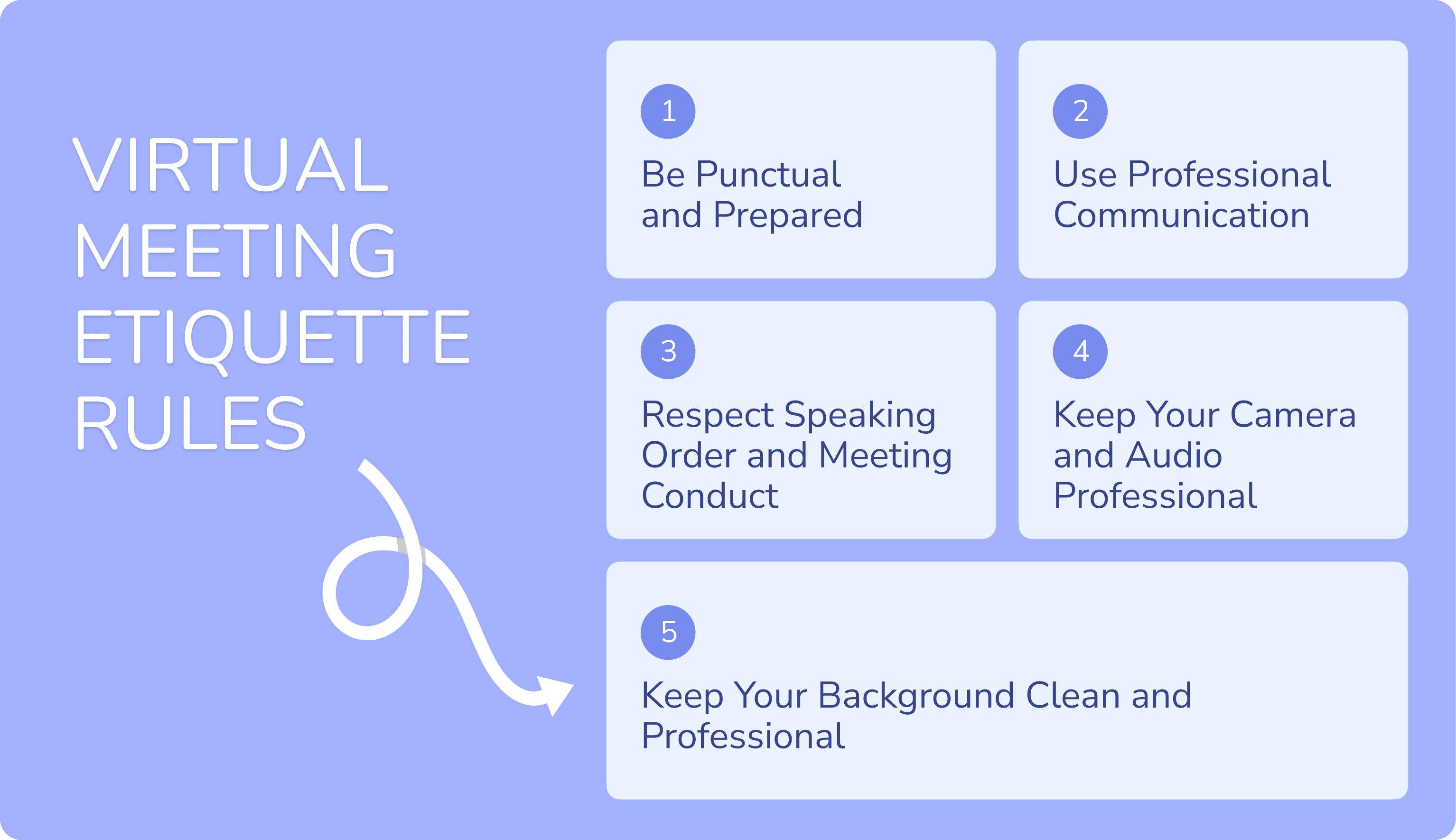
Be Punctual and Prepared
Joining “just one minute late” might seem harmless.
Online, it isn’t. When you arrive late, the meeting pauses. Someone summarizes what you missed.
Focus shifts.
Now multiply that by three late participants.
Being punctual in virtual meetings signals reliability. It says: this conversation matters.
Preparation matters just as much.
Before joining:
- Review the agenda
- Know your role
- Prepare updates or questions
- Check your tech
Remote meetings move quickly. If you’re not ready, everyone feels it.
Professional etiquette starts before the call even begins.
Use Professional Communication
Online communication leaves less room for nuance.
Tone can sound sharper.
Silence can feel awkward.
Interruptions can feel aggressive.
Speak clearly.
Be concise.
Avoid rambling.
Structure your thoughts:
- State the context
- Make your point
- Suggest next steps
If you disagree, do it respectfully.
If you’re confused, ask for clarification instead of pretending to understand.
Professional communication isn’t about sounding formal.
It’s about being clear.
Respect Speaking Order and Meeting Conduct
Virtual calls can quickly turn chaotic. People talk over each other. Someone interrupts mid-sentence. Audio lags create awkward overlaps. Respecting speaking order is essential in remote meetings.
- Pause before responding.
- Use the “raise hand” function if needed.
- Let others finish their thought.
Meeting conduct also includes staying present. If you’re multitasking, people can tell. Delayed reactions, wrong answers, repeated questions — they all signal disengagement. And disengagement damages credibility.
Keep Your Camera and Audio Professional
Your microphone and camera are your digital body language.
Unstable audio, echo, background TV, or loud typing instantly distract everyone.
Before joining:
- Test your microphone
- Use headphones if possible
- Mute when not speaking
Camera matters too. You don’t always have to be on camera — but if your team culture expects it, respect that norm. Position your camera at eye level. Sit in good lighting. Avoid dramatic shadows or backlighting. In virtual meetings, how you appear influences how seriously you’re taken.
Keep Your Background Clean and Professional
Your background says more than you think.
Cluttered spaces, movement behind you, or chaotic visuals pull attention away from the discussion.
- Choose a clean, neutral environment.
- If necessary, use a simple virtual background — not something distracting.
- The goal isn’t perfection.
It’s minimizing distraction.
When people don’t have to process your surroundings, they can focus on your message.
Virtual meeting etiquette rules are not about being rigid. They are about reducing friction. The fewer distractions, the more clarity. The more clarity, the better the outcomes. And that’s where many teams realize something important: Good behavior improves meetings. But structure is what makes them effective.
Practical Virtual Meeting Etiquette Tips You Can Apply Today
You don’t need a new policy document to improve virtual meeting etiquette. Small, consistent habits make the biggest difference. Here’s a simple before–during–after framework you can apply immediately.
.webp)
1. Before the Meeting
Most virtual meeting etiquette problems start before the call even begins. If you rush into a meeting unprepared, distracted, or technically unstable, the entire conversation starts at a disadvantage.
Test your audio and camera.
Nothing disrupts online meetings more than “Can you hear me?” repeated five times. Check your microphone, camera angle, and lighting before joining.
Join 2–3 minutes early.
Those few minutes create mental transition time. You’re not jumping from one task into another mid-sentence. You’re ready.
Review the agenda.
If there’s an agenda, read it. If there isn’t — ask for one. Virtual meeting etiquette isn’t only about behavior. It’s about respecting purpose.
Close unrelated tabs.
If your inbox is open, your attention will drift. If Slack is flashing, you’ll be tempted. Close everything that isn’t relevant. Presence is visible — even through a screen.
Preparation signals professionalism before you even speak.
2. During the Meeting
This is where most online meeting etiquette mistakes happen. And most of them are surprisingly small.
Keep your microphone muted when not speaking.
Background noise is amplified in remote meetings. A single unmuted mic can derail focus instantly.
Avoid eating or multitasking.
Yes, you’re at home. But the meeting is still professional. Multitasking might feel efficient — but delayed responses, missed context, and repeated questions show the opposite.
Maintain visual engagement.
You don’t need to stare intensely at the camera. But look present. Nod. React. Respond. Silence and blank expressions create uncertainty.
Take structured notes.
Don’t just capture random sentences. Write decisions, commitments, and next steps clearly. If someone says, “I’ll handle that,” note the name and the deadline.
Virtual meeting etiquette during the call is about minimizing friction and maximizing clarity.
3. After the Meeting
This is the most underestimated part of virtual meeting etiquette. And often the most important. The meeting may have gone smoothly, but if nothing happens afterward, it failed.
Send a clear summary.
Recap the key decisions and align everyone. Don’t assume everyone interpreted the discussion the same way.
List action items with owners.
Tasks without names are not tasks. Their wishes.
Confirm deadlines.
“When possible” and “soon” are not deadlines. Be specific.
Convert decisions into tasks immediately.
This is where many teams struggle. Notes stay in documents. Action items stay in chat. Nothing moves.
That’s why more remote teams now rely on AI-powered systems that turn spoken commitments into structured AI notes, automatically assign tasks through an AI planner, and even schedule follow-ups instantly. Instead of manually rewriting meeting notes, decisions can become calendar events and tracked tasks in seconds.
When discussions automatically translate into execution, virtual meeting etiquette becomes more than behavior — it becomes productivity.
Many professionals still rely on scattered notes or memory after meetings. AI voice task managers now allow teams to turn spoken commitments directly into structured tasks and calendar events — eliminating the gap between discussion and execution.
Good etiquette creates respect. Structured follow-through creates results.
From Meeting Etiquette to Measurable Outcomes
Virtual meeting etiquette is not only about politeness, camera positioning, or speaking order. It is about ensuring that every meeting leads to clarity, accountability, and action.
In remote and hybrid teams, the biggest problem is not behavior during the call, it is what happens after the call.
- Decisions stay in notes.
- Action items are forgotten.
- Follow-ups get delayed.
Professional meeting etiquette includes one critical step: turning discussion into structured outcomes.
Modern teams increasingly use AI-powered tools that automatically convert voice discussions into organized summaries, clear action items, and scheduled tasks. Instead of manually rewriting meeting notes, professionals can rely on systems that capture decisions in real time and distribute responsibility immediately.
For distributed teams especially, this transforms meeting etiquette from a set of rules into a measurable productivity practice.
When meetings end with clarity — and tasks are automatically structured — etiquette becomes operational excellence.
If your team wants meetings to result in clear tasks instead of scattered notes, structured AI voice tools like Voiset can help ensure nothing discussed gets lost.

