


.webp)
Why task management is critical for business?
The answer is simple! According to CB Insights analysis, [42% of startups fail due to lack of market need and poor execution] - not from lack of ideas, but from poor execution.
Almost everyone has an idea in mind. A successful entrepreneur must have the ability to organize processes. The more complex the system they build, the greater the value they create and the higher the profit they generate.
An entrepreneur is, first and foremost, a coordinator of processes. They create tasks for their team, monitor execution, and ensure everything moves forward. Success depends entirely on how well these processes are structured.
Ideally, people are self-organized - capable of setting tasks for themselves and others without reminders. But new entrepreneurs rarely have this experience. Instead, chaos begins: endless chat threads, tasks scattered across notebooks, Notion pages, to-do apps, and Trello boards.
But tools alone don't solve the problem. A task remains just a task until someone manages it, tracks it, and ensures it gets done. It should be a simple system to manage business processes that saves time instead of wasting it.
Every business should have a backlog of tasks!
Every company, without exception, has a backlog of tasks from day one. Starting a business is itself a task register the company, open a bank account, and so on. The difference between business tasks and personal ones is that business survival and goal achievement depend on their execution. We've already discussed the concept of Stretch Goals in Business on our blog. Therefore, the best approach is to divide your backlog by projects and create a list of tasks ready to move into active work.
.webp)
Capture everything — tasks, notes, ideas, etc.
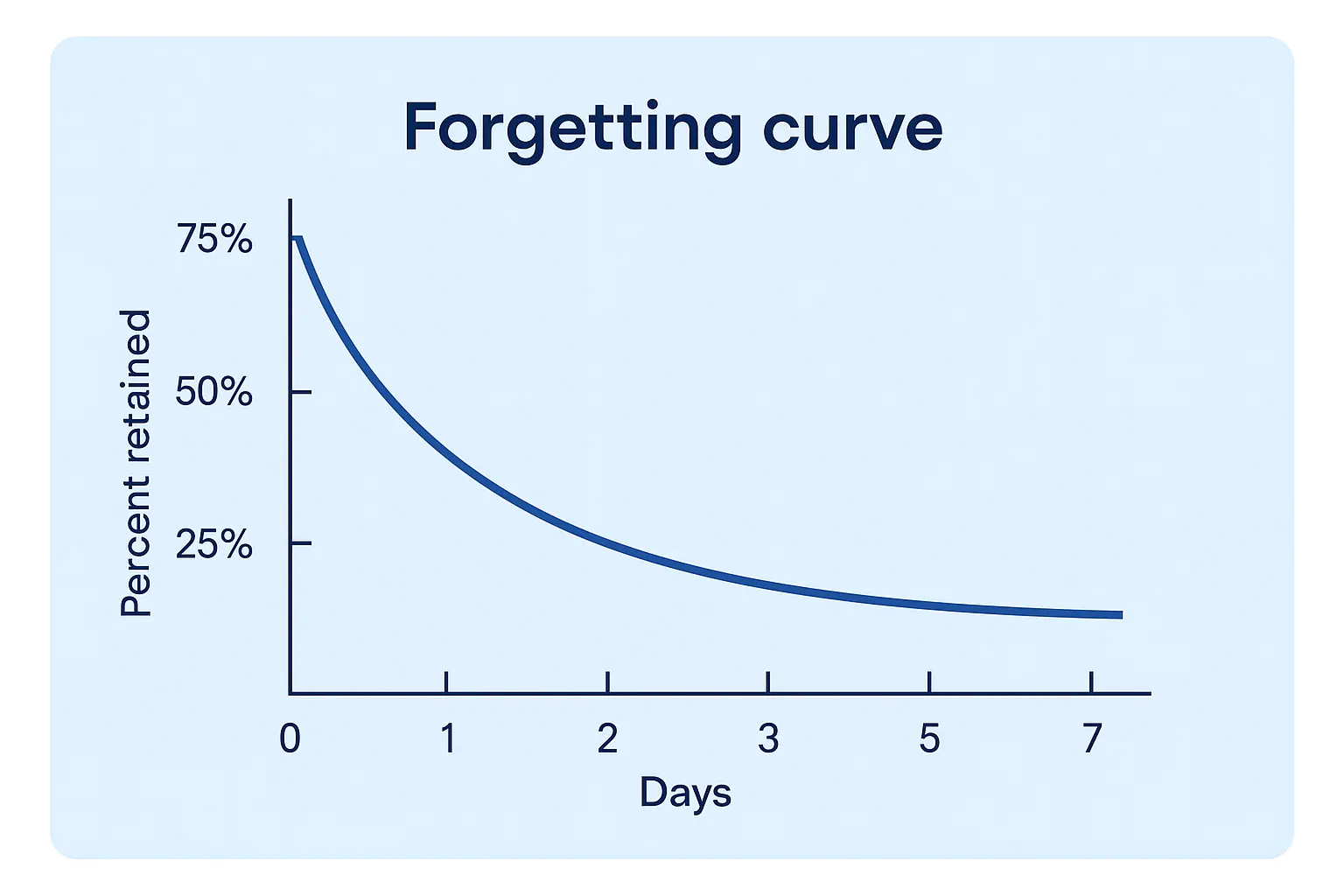
Remember this simple rule: If you don't write it down, you'll forget it. That's how our brains work. We lose up to 90% of new information within just 7 days. This means you need to capture absolutely everything—tasks, event notes, ideas, plans, everything.
Saw something interesting online but don't have time to read it now? Save it immediately. Heard about a grant opportunity? Write it down instantly so you can return to it later when you have time.
This is why one-click capture is critical. The easier it is to record information, the more likely you'll actually do it. Press one button, speak what you need to remember - done. This is exactly what tools like Voiset enable: effortless capture so nothing slips through the cracks.
Each task needs an owner
Here's the next critical rule: Every task must have an assigned owner. Without one, it remains just a plan and will be forgotten.

The key difference between a task and a note is accountability. A task is a commitment to action, which means someone must be responsible for executing it. A note, on the other hand, can exist without an owner—it's just a thought or observation. However, you should always be able to convert a note into a task when needed. This is the essence of AI notes: capturing information that can instantly transform into actionable tasks.
But how do you assign tasks correctly? There are various techniques for determining ownership, with the RACI matrix being the most popular. It helps identify who is Responsible, Accountable, Consulted, and Informed for each task. The Project Management Institute [emphasizes that clear role definition reduces project delays by up to 40%]
Assigning the right person is crucial. It can dramatically accelerate execution.
Think of it like eating soup with a fork: technically possible, but painfully slow. Why struggle when you have the right tool a spoon available?
When the right person owns the task, work flows naturally. When the wrong person is assigned, progress stalls.
Prioritize incoming tasks
When you have many tasks, effective prioritization becomes essential. The key is understanding what's truly important and what's realistically achievable.
Not everything can be marked as "urgent" or "critical" -if everything is urgent, nothing is.
The most important skill is determining what needs to be done now versus what can wait. Among your entire task list, identify what's "on fire" and handle it first. At the same time, avoid letting tasks reach critical urgency. If you can complete an important task in advance, do it.
AI can only partially assist with prioritization. Only you can determine what truly matters for your business. However, AI assistants can support you by:
- Constantly reminding you about repeatedly postponed tasks
- Automatically rescheduling and replanning your workload
- Ensuring nothing falls through the cracks
The human judgment remains irreplaceable—you set the priorities. AI simply ensures you don't lose track of them.
Task management Is a long game - Don't let It stress you out
.webp)
Success Is Made Up of Many Small Steps
Business and startups are always a marathon, not a sprint. Nothing happens quickly. Every day brings new challenges that must be overcome. But it's critical not to accumulate stress along the way.
Take a common example: when someone on your team leaves, it's essential to redistribute their tasks properly so nothing gets lost. This is where task management systems become invaluable - they provide visibility into who's working on what and help prevent work from falling through the cracks.
Modern task management tools do more than organize work - they help balance workload across your team. They assess each team member's capacity, visualize the entire system, and help distribute tasks evenly. This prevents burnout and keeps everyone productive.
We've explored this topic in depth in our article on Stress Management and Balance in Everyday Life. The key insight: a transparent task management system reduces stress by making workload visible and manageable.
But remember: Everyone needs time for rest and personal life. Even the best task management system can't replace the need for balance. Build that time into your planning, not as an afterthought, but as a non-negotiable requirement.
Delegate as many tasks as possible
Task management doesn't mean that you are looking for the 25th hour in your schedule so that you can get a little more done. Managing means distributing tasks competently among all team members. That's why managing a new business involves the owner's efforts to find new customers in the first place. It's better to hire individuals to deliver goods, manage social media, and other duties.
Use task managers!
Studies show that effective process management can [increase productivity by 20-30%] in early-stage companies.
The market offers a wide spectrum of task management solutions from lightweight personal planners to enterprise-grade project management platforms. Choosing the right one depends entirely on your business needs and team size.
Think of it like buying a car: all vehicles get you from point A to point B, but the driving experience and features can vary dramatically. A startup founder doesn't need a semi-truck when a compact sedan will do the job perfectly.
For business, simplicity in task creation is critical. The principle should be straightforward: sit down, press a button, create a task - done. Too often, task management itself becomes more time-consuming than actually completing the tasks. When your system requires 10 clicks and 5 form fields just to capture a quick idea, you've already lost valuable momentum.
If you're just starting your business, avoid overengineered solutions. Complex tools like Jira or Asana offer powerful features, but they come with steep learning curves. Jira requires technical expertise to configure boards and workflows. Asana, while feature-rich, can overwhelm new users with its extensive functionality right out of the box.
The AI-powered task management space has exploded recently, with solutions like Motion, Reclaim AI, Wrike, Monday.com, and ClickUp entering the market. These platforms offer diverse - often excessive - functionality for project planning. While impressive, this abundance of features comes at a significant monthly cost, and most early-stage businesses simply don't need 80% of what they're paying for.
The smarter approach: Start with tools that let you set up your project in just a few clicks - solutions like Trello, Todoist, or Voiset. Among these, Voiset stands out for its laser focus on one-click task creation without unnecessary complexity. No elaborate onboarding, no feature overload - just effortless capture when inspiration strikes.
The goal isn't to master a complicated system - it's to free up your time for what truly matters: scaling your business. When task management becomes automatic rather than administrative, you can focus on growth instead of drowning in setup and maintenance.
Using digital task management tools to grow your business
The growth of a small business today depends directly on the company's ability to establish reliable internal processes. What once took years to organize can now be structured in months or even weeks - thanks to modern digital tools and AI-powered automation.
The key is choosing systems that eliminate friction rather than create it. Your task management solution should fade into the background, supporting your workflow without demanding constant attention or maintenance.
Start simple, build systematically, and scale deliberately. The businesses that thrive aren't those with the most sophisticated tools - they're the ones that execute consistently, day after day, without getting lost in operational chaos.

